9 September 2026
Coding agents: AI that automates repetitive coding tasks, with a Mapleroot section.
Coding agents, AI tools that can write, test, and refine code with minimal supervision, are one of the fastest growing categories in AI right now. What sets the newest wave apart isn't just that they write code, it's that many of them let developers choose their own underlying model rather than being locked into a single vendor, running from a terminal, an IDE, or a desktop app.
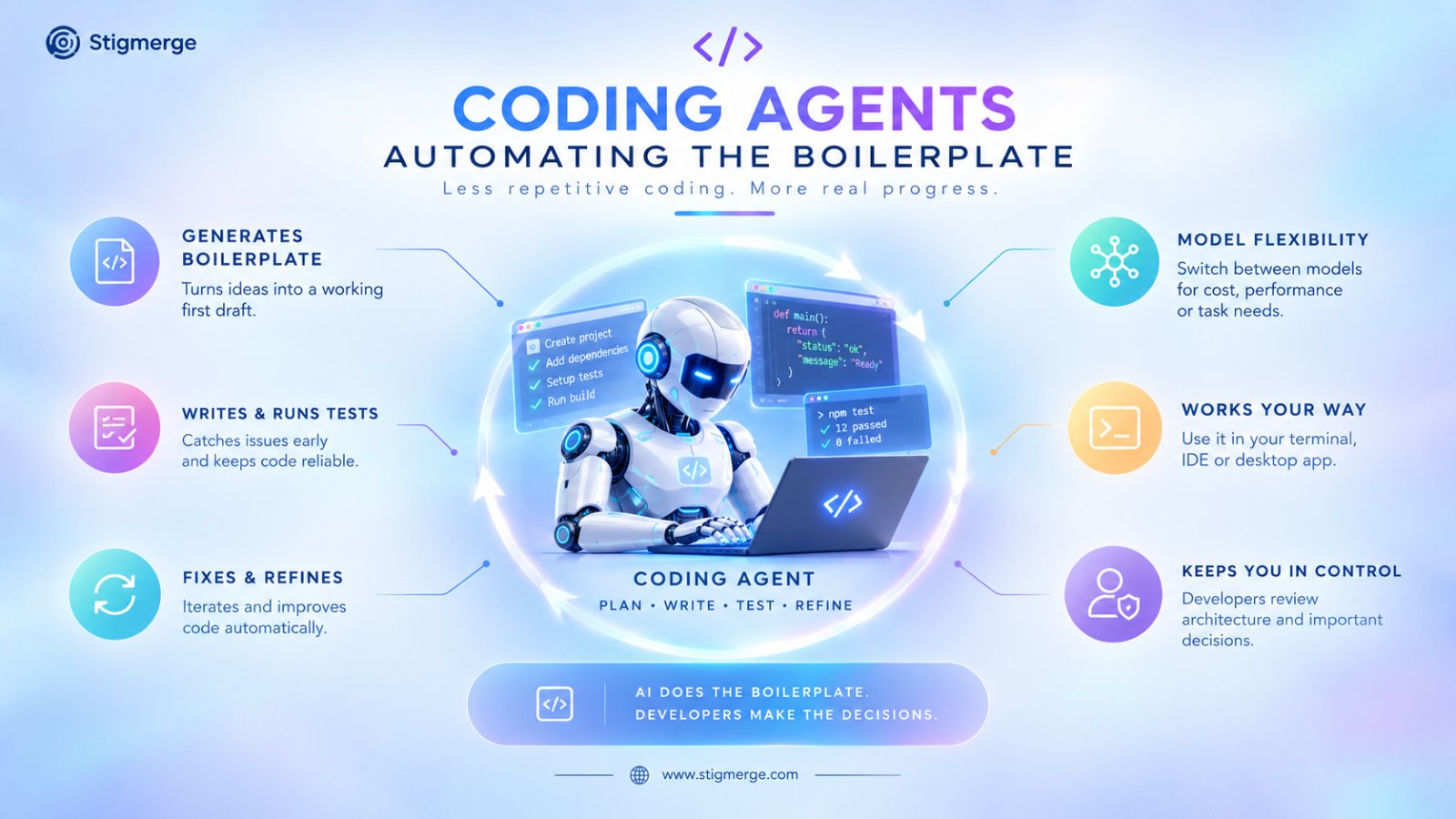
Coding Agents: Automating the Boilerplate Coding agents, AI tools that can write, test, and refine code with minimal supervision, are one of the fastest growing categories in AI right now. What sets the newest wave apart isn't just that they write code, it's that many of them let developers choose their own underlying model rather than being locked into a single vendor, running from a terminal, an IDE, or a desktop app. Why Coding Agents Are Taking Off Writing code has always involved a mix of genuine problem solving and repetitive mechanical work: setting up boilerplate, writing test cases, fixing formatting, wiring together functions that already exist elsewhere. Coding agents are proving especially good at that second category. They can take a rough description of what's needed, generate a first working version, run it, catch errors, and iterate, often without a developer stepping in until something needs a real decision. This matters because the mechanical parts of coding are exactly the parts that don't require deep expertise but still take real time. Offloading that to an agent frees developers to spend more time on architecture, design decisions, and the parts of a project that actually need human judgment. The Shift Toward Model Independence An interesting detail in this trend is the growing preference for coding agents that aren't tied to one specific AI provider. Developers increasingly want the flexibility to switch models depending on cost, performance, or specific task needs, rather than being locked into whatever model a single tool happens to use. This has driven strong growth for open agent frameworks that work across different model providers, treating the underlying model as a swappable component rather than a fixed part of the tool. A Related Example: Mapleroot This trend is worth considering for Mapleroot as well. If any part of Mapleroot's work involves writing or maintaining code, whether that's internal tools, scripts, or larger systems, a coding agent could take over the more repetitive parts of that work: generating boilerplate, writing test cases, or converting a rough idea into a first working draft. Rather than a developer manually writing every piece from scratch, the agent could handle the mechanical first pass, leaving the actual review, design decisions, and judgment calls to the person overseeing the work. The value isn't replacing that judgment, it's cutting down the time spent on the parts of coding that don't really need it. The Takeaway Coding agents aren't reducing the need for skilled developers, they're changing what developers spend their time on. As these tools get better at handling the repetitive parts of writing code, the more valuable skill becomes knowing what to build and reviewing whether it was built correctly, rather than typing out every line by hand.