9 September 2026
Multimodal AI: AI that reads images, audio, and documents directly, not just text, with a Maple root section.
For years, most AI tools were built around a single input: typed text. You typed a question, you got a text answer. That's changing fast. AI systems today are increasingly multimodal, meaning they can read and reason across screenshots, PDFs, handwritten notes, photos, audio, and video, not just plain text.
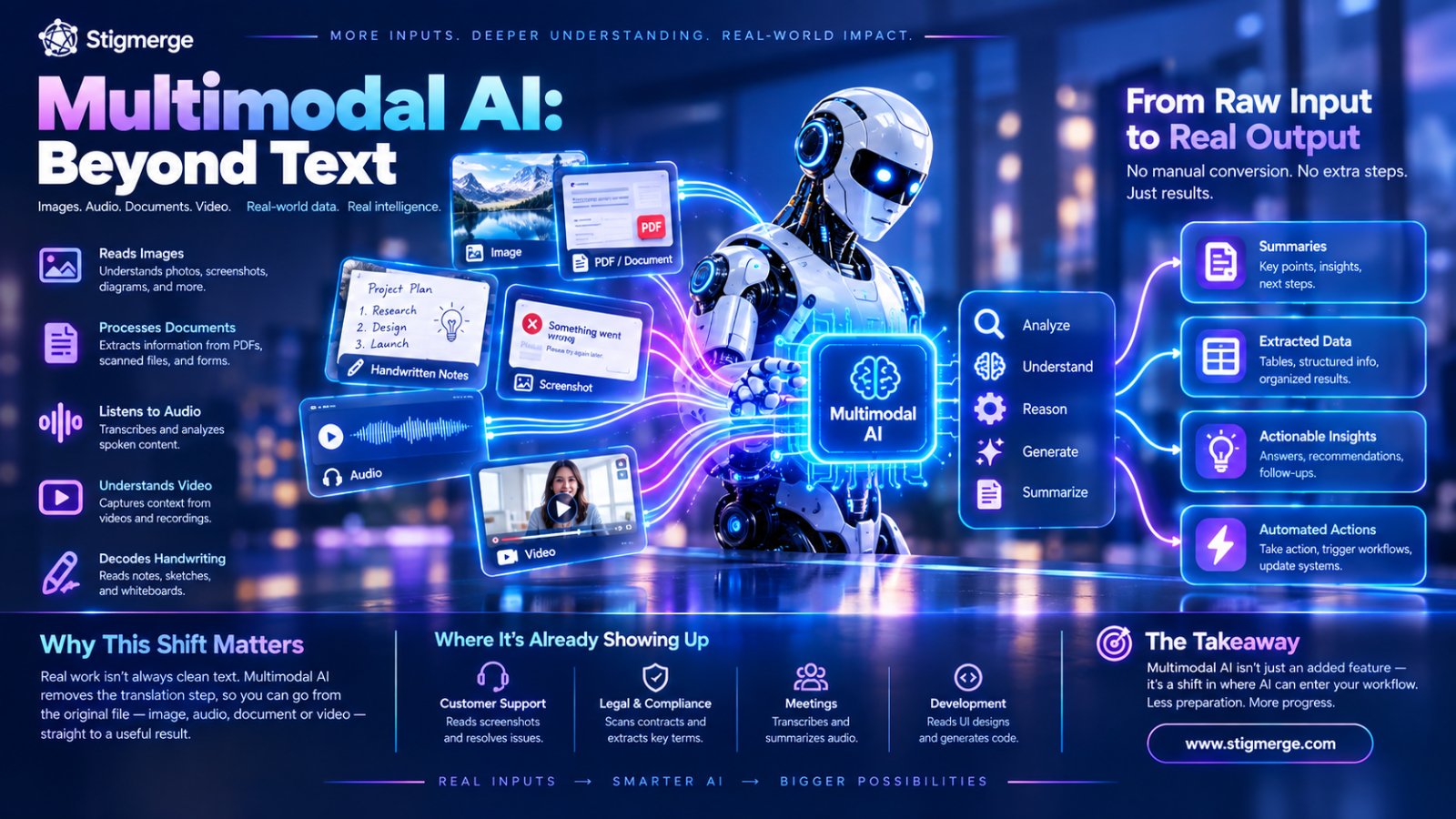
Multimodal AI: Beyond Text For years, most AI tools were built around a single input: typed text. You typed a question, you got a text answer. That's changing fast. AI systems today are increasingly multimodal, meaning they can read and reason across screenshots, PDFs, handwritten notes, photos, audio, and video, not just plain text. Why This Shift Matters A huge amount of real work doesn't start as clean, typed text. It starts as a photo of a whiteboard, a scanned form, a recorded call, a screenshot of an error message, or a diagram sketched during a meeting. For a long time, using AI on that kind of material meant manually converting it into text first, typing it out, transcribing it, describing it in words, before the AI could actually help. Multimodal AI removes that translation step. A tool that can directly read an image, listen to audio, or parse a PDF's layout can go straight from the raw, messy input people actually work with to a useful output, without a human doing the tedious conversion work in between. Where It's Already Showing Up This trend is visible across a wide range of use cases. Customer support tools now read screenshots customers send in in and identify what's on screen. Legal and compliance teams use AI to scan and extract terms from scanned contracts rather than retyping them. Meeting tools transcribe and summarize audio directly. Even coding tools are starting to read a screenshot of a UI design and generate the matching code. The practical effect is that AI is becoming useful earlier in a workflow, at the point where information is still raw and unstructured, rather than only after someone has already cleaned it up. A Related Example: Mapleroot This is worth considering for Mapleroot too. If any part of Mapleroot's work involves information that starts out as an image, a scanned document, a recording, or anything other than clean typed text, a multimodal approach could cut out a real bottleneck. Instead of someone first transcribing a document or describing an image in words before AI can process it, a multimodal tool could work directly from the original file, whether that's a photographed document, a screenshot, or an audio recording, and produce a usable result straight away. The time saved isn't in the AI's reasoning itself, it's in eliminating the manual step of converting raw material into a format AI can use. The Takeaway Multimodal AI isn't just an added feature, it's a shift in where AI can enter a workflow. As more tools become comfortable working directly with images, audio, and documents, the bottleneck moves away from data preparation and toward the actual decisions people need to make with that information.